
Realistic Paintings Aren’t Real
Lately I’ve been making a shift in my work.
Some would call it abstracted figuration; some might call it disrupted realism — a phrase I have borrowed from the book Disrupted Realism by John Seed.
In the book, Seed suggests that cultural shifts — particularly the speed and fragmentation of modern life — have altered how artists approach realism. We no longer necessarily seek faithful photographic representation because our experience of the world is faster and fractured, so perhaps realism has changed too.
Re-reading that book this week made me question the very idea of realism.
What do we actually mean when we say a painting is realistic?
Do we mean it looks like a photograph? Do we mean the painting is so convincing that we struggle to tell the difference between the painted surface and a camera image?
See, to me, that kind of painting doesn’t feel very realistic at all. When I look at a person, I do not see them frozen. Even when they are sitting still, they are in motion. An expression flickers across their face. A thought alters their posture. A hand shifts or a foot taps. And beneath all of that, there is something else — a hum of life or presence or energy or soul (choose your preferred word!)
A photograph freezes all of that - it captures a split second and presents it as fixed even though life doesn’t feel fixed.
So perhaps what we call “disruption” — the breaking, blurring, obscuring, losing and finding again — is not a departure from realism at all. Perhaps it is realism.
The painting below (almost finished) is based on a photograph of me between the ages of one and two.
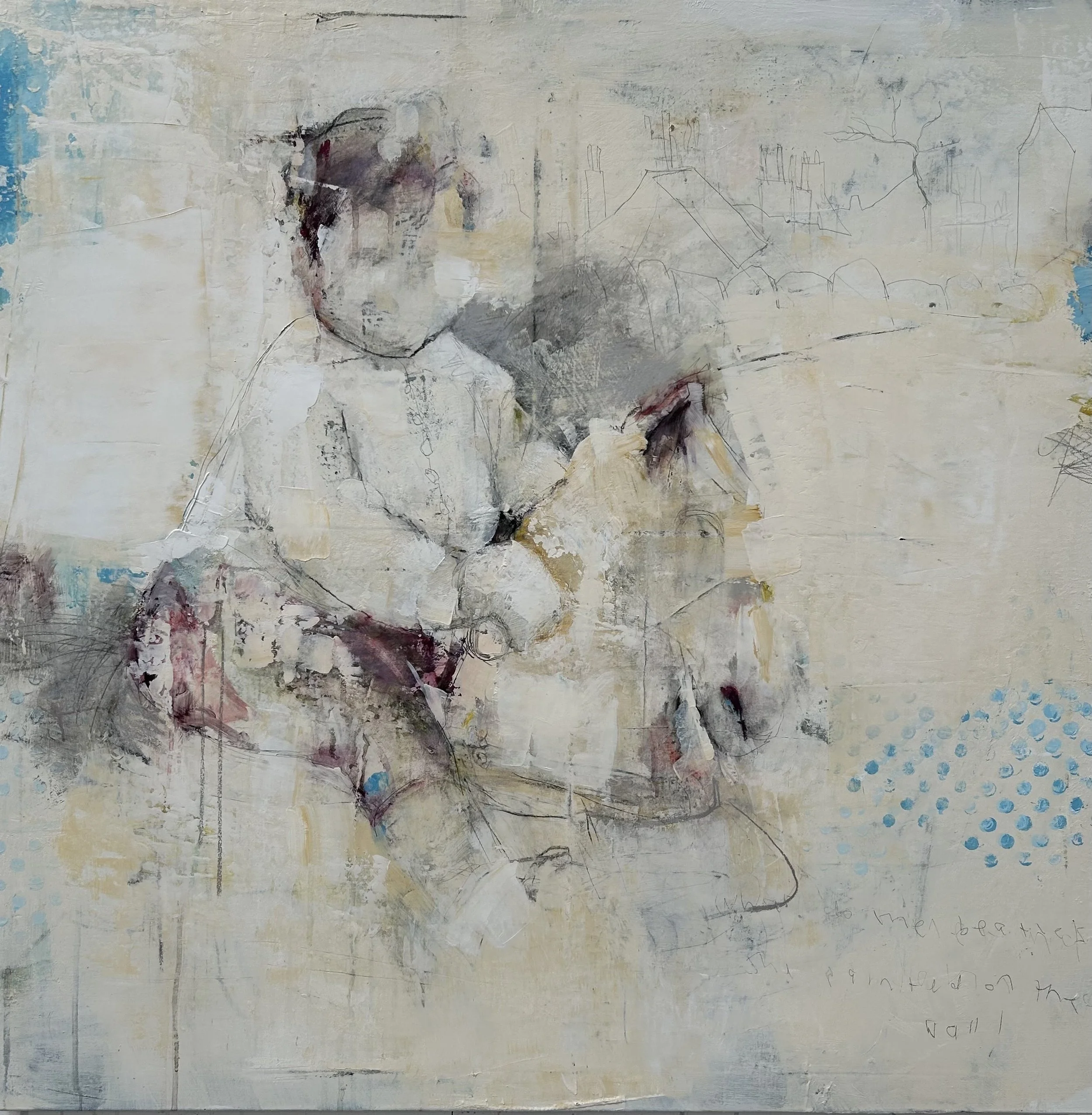
I don’t remember this moment because I was too young. I've heard stories about it - how a photographer cam to the house and offered to take some snaps and this was my mum's favourite. But I have no recollection of it myself.
Given that, it would feel entirely unrealistic to paint a careful copy of that photograph.
Instead, I’ve disrupted the face and body — and the horse — so that the figure floats in and out of clarity. There is nothing solid about it. The forms emerge and dissolve and that feels truthful.
It feels much closer to how memory behaves — partial, unstable, and layered with what we now know, rather than what it actually felt like in the moment.
Why Does the Label Matter?
When I shared some of these thoughts on Instagram, a few people asked: why does it matter what we call it? Why categorise at all?
It’s a fair question. I don’t particularly enjoy pigeon-holing things either, but for me this distinction is useful. It helps me clarify what I’m doing and why. (And if I don’t know what I’m doing or why I’m doing it, I lose interest very quickly).
So for now, I’m choosing to describe myself simply as a figurative painter who uses my knowledge of abstraction to express more than appearance.
That definition gives me something to test my work against.
When I think a painting is finished, I can ask:
Does this painting resemble the person or thing it represents? (This matters to me fort his series.)
Does it convey more than how that person looks?
What, exactly, is it conveying?
What the Paintings Reveal
So far I’ve completed five of these works, all based on family photographs. Each one has ended up meaning something different.
And here’s the part I find most fascinating: the meaning only becomes clear during the making.
As I begin to disrupt the surface — to push and pull between finding and losing the likeness, something reveals itself. Memories start to surface and I begin to make decisions of composition or colour that feel instinctive but soon reveal a logic.
And at some point I realise what it is about - not just who is in it, but what it holds.
That understanding doesn’t come from copying the photograph faithfully. It comes from allowing the image to destabilise. The disruption is where the meaning lives.
And perhaps that is the most realistic thing of all...