

Somewhere Around Minute Ten
This week I went to my second life drawing class. What surprised me was that I kept running into the same problem.
When we're doing two-minute poses, I quite like my drawings. They're loose and energetic and sometimes there will be a mark or a line that catches my attention. They feel alive somehow. Five-minute poses are usually OK too - but then comes the thirty-minute pose.
You would think more time would help, wouldn't you?
But for me, the opposite happens. I start tightening up. The drawing becomes more careful. I start correcting things. The marks become less interesting. By the end, I always prefer the quick sketches I did at the beginning.
Check this out and see if you can see what I mean - one took two minutes and one took 30 minutes.
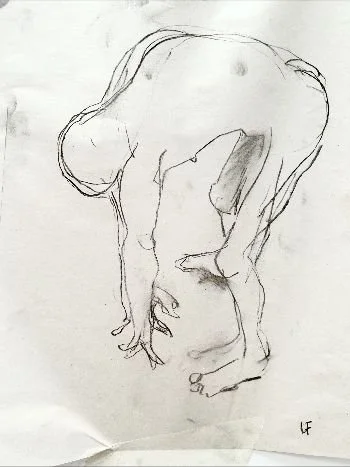
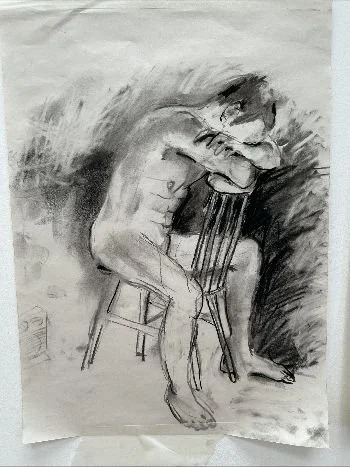
Yes, the one on the right is more accurate - but the one on the left is much more interesting to me. It has personality - it contains my energy somehow.
I started thinking about what changed - after all, I'm working in the same room with the same materials and the same model. And by the time we get to the 30-minute pose, we've already been drawing for an hour or more, so I would expect to feel more loose and relaxed.
I decided that the only thing that has really changed is that suddenly there is enough time to think, to start worrying about proportion and accuracy, and to feel like this one really matters because it's an investment of time.
I see the same thing happen with artists all the time.
My students are usually quite happy while they're playing. They'll experiment with materials, fill sketchbooks, make studies, try "out there" ideas and follow all sorts of interesting tangents.
Then they decide it's time to make a "real painting" and everything changes.
The sketchbook page didn't feel important. Neither did the experiments on loose sheets of cheap paper. If they failed, who cared?
But a painting feels different. Suddenly there is something at stake.
I've seen it many times in Momentum. Students are often at their most adventurous when I give them playful assignments. They're willing to test things and make discoveries because they haven't decided that the outcome is important yet.
The moment they start thinking about the finished work, some of that freedom disappears.
Perhaps that's why some of our most interesting work ends up hidden away in sketchbooks. It's not anything special about sketchbooks themselves - rather it's that we're behaving differently when we make them.
I've been thinking about this since yesterday when I got back from the life drawing class.
I don't think my problem is that I need more practice - I'm quite skilled at seeing and responding. I don't think it's a lack of confidence either - I know I can do this.
So what is it?
I think somewhere around minute ten, I stop drawing and start performing. There's am imaginary chorus of critics in my head and I am subconsciously trying to please them, which is why I sow down, get more tentative, and start correcting myself rather than allowing my marks to remain as they were made..
How many times have I done exactly the same thing in the studio? How many paintings have become less interesting because I started treating them as important? How many times I've abandoned curiosity in favour of trying to get it right?
I'm not sure I have an answer, but I suspect there is something worth paying attention to there.
btw - if you live in the North East, you might be interested in the life drawing classes. I can recommend Sarah as a teacher. At the moment there are no classes listed, but more will be added and you can always email her to inquire. https://sarahnelsonstudio.co.uk/workshop-events/